MAST: Barbara A. Mikulski Archive for Space Telescopes
Map of the Universe from Johns Hopkins University and others.....
Johns Hopkins University (JHU) continues to pad its space community résumé with their interactive map, “The map of the observable Universe”,
 that takes viewers on a 13.7-billion-year-old tour of the cosmos from the present to the moments after the Big Bang.
 While JHU is responsible for creating the site, additional contributions were made by NASA, the European Space Agency,
 the National Science Foundation, and the Sloan Foundation.
JWST's weekly observing schedule:
NASA's Unverse of Learning
An Integrated AstroPhisics STEM Learning and Literacy program
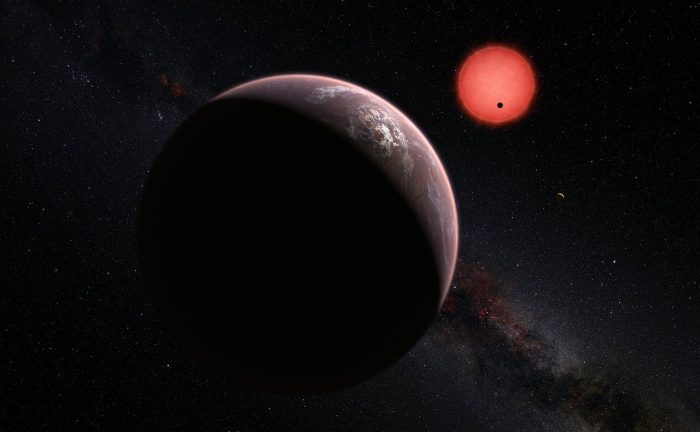
Artist's impressions of three newly-discovered exoplanets orbiting an ultracool dwarf star TRAPPIST-1.

 Credit: ESO/M. Kornmesser/N. Risinger (skysurvey.org).
Location of TRAPPIST-1 in the constellation Aquarius. Credit: ESO/IAU and Sky & Telescope.
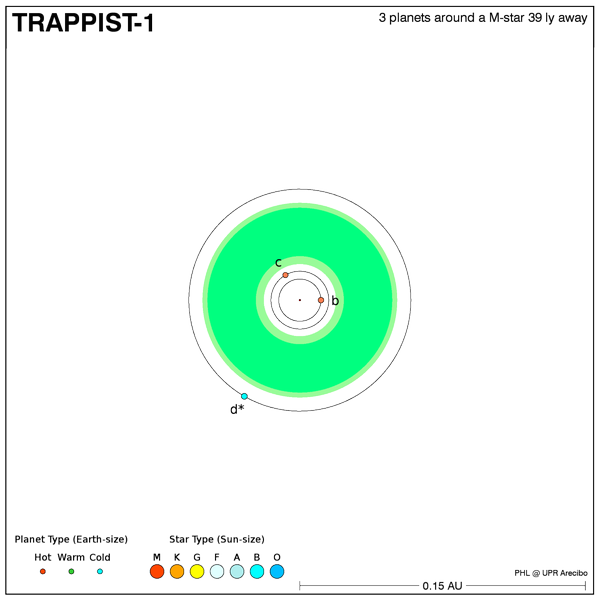
Structure of the TRAPPIST-1 exosystem. The green is the star’s habitable zone. Credit: PHL.
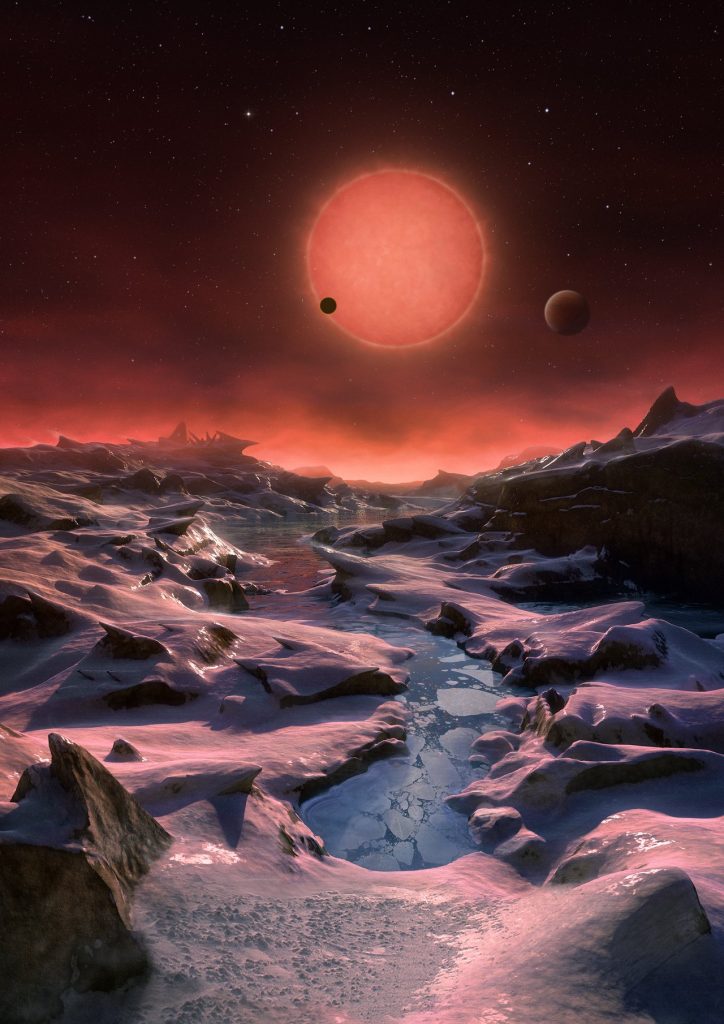
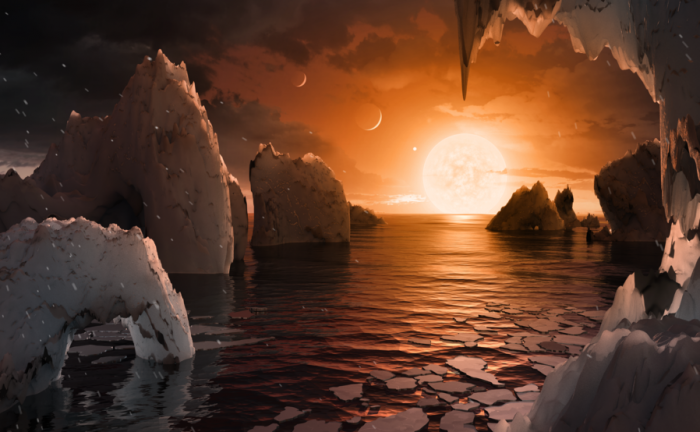
Artist’s impression of the view from the most distant exoplanet discovered around the dwarf star TRAPPIST-1.

 Credit: ESO/M. Kornmesser.
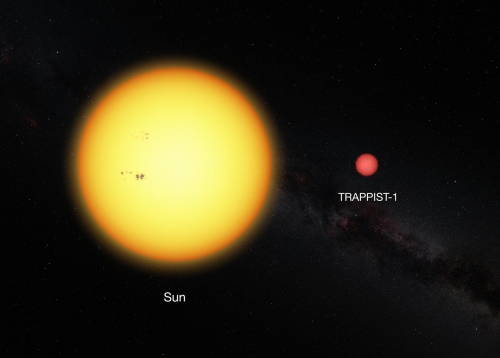
Image: Comparison between the Sun and the ultracool dwarf star TRAPPIST-1. Credit: ESO.

That’s a useful insight because we have no other information about the nature of these planets.

 Their masses have not been measured, and we have no other data about the kind of planets that can exist

 around ultracool dwarf stars (TRAPPIST-1 is an M8 dwarf) because the TRAPPIST-1 worlds are our first transiting example.

The excerpt below shows the team’s reasoning, building on the fact that the lack of features in the combined spectrum

rules out certain kinds of atmospheres:
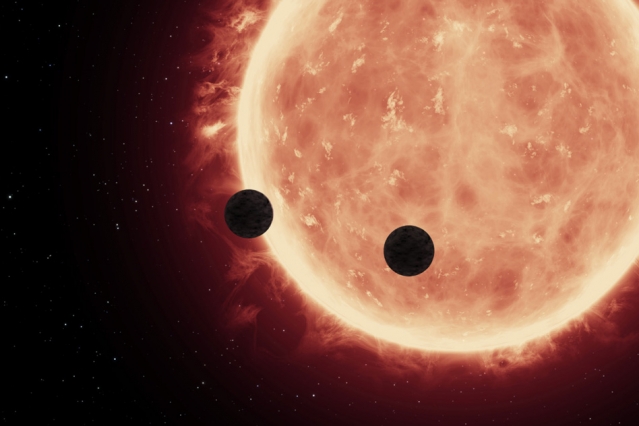
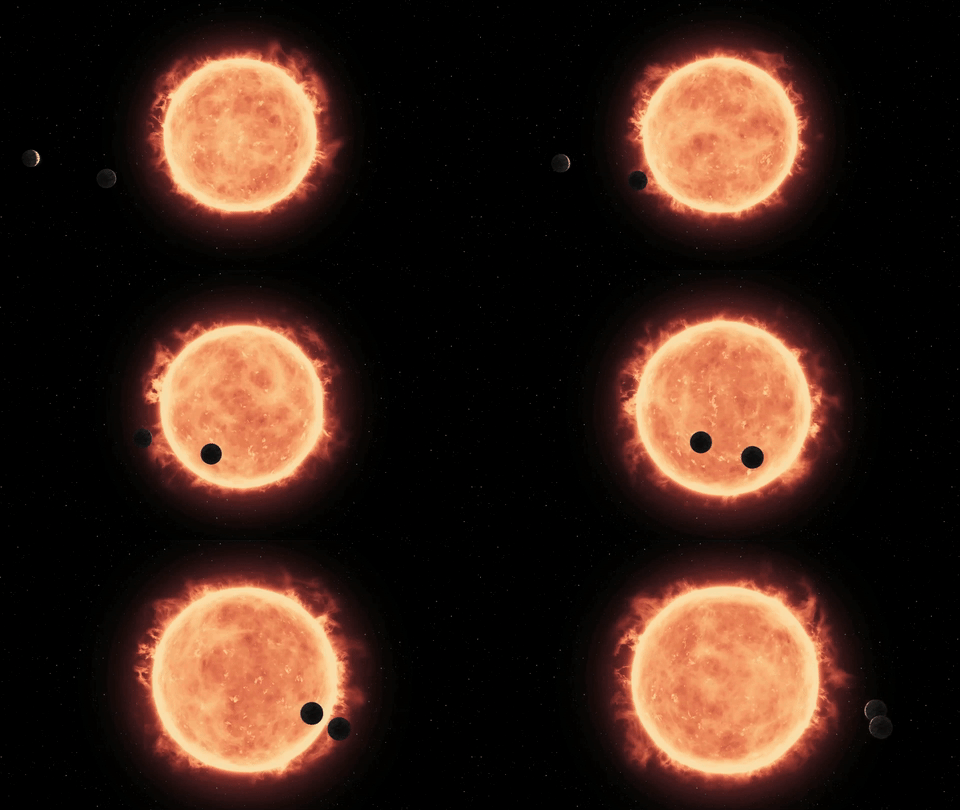
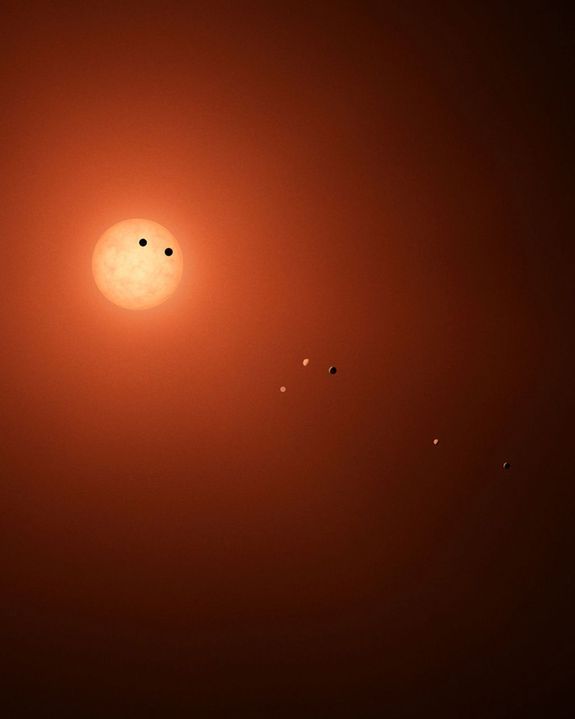
Image: The binary transit visualized. Credit: NASA/ESA/STScl.
With an extended gas envelope ruled out, we wind up with a range of possible atmospheres,

ranging from the CO2-dominated Venus to an Earth-like atmosphere with heavy clouds or a depleted atmosphere

like what we see on Mars. To push further into the possibilities, the team has formed a consortium called

SPECULOOS (Search for habitable Planets Eclipsing ULtra-cOOl Stars), the good news being that they are building

larger versions of the TRAPPIST instrument in Chile that will focus on the brightest ultracool dwarf stars in the southern hemisphere.

 Consider the effort an attempt to build the kind of pre-screening tools that our future space telescopes like the

 James Webb instrument will need for their target list.
The paper is de Wit et al., “A combined transmission spectrum of the Earth-sized exoplanets TRAPPIST-1 b and c,” Nature 20 July 2016 (preprint).

 The discovery paper is Gillon et al., “Temperate Earth-sized Planets Transiting a Nearby Ultracool Dwarf Star,”

 published online in Nature 2 May 2016 (abstract). An MIT news release is available
HUGE NEWS, SEVEN EARTH-SIZED WORLDS ORBITING A RED DWARF, THREE IN THE HABITABLE ZONE
Seven New Earth Sized Worlds Discovered?
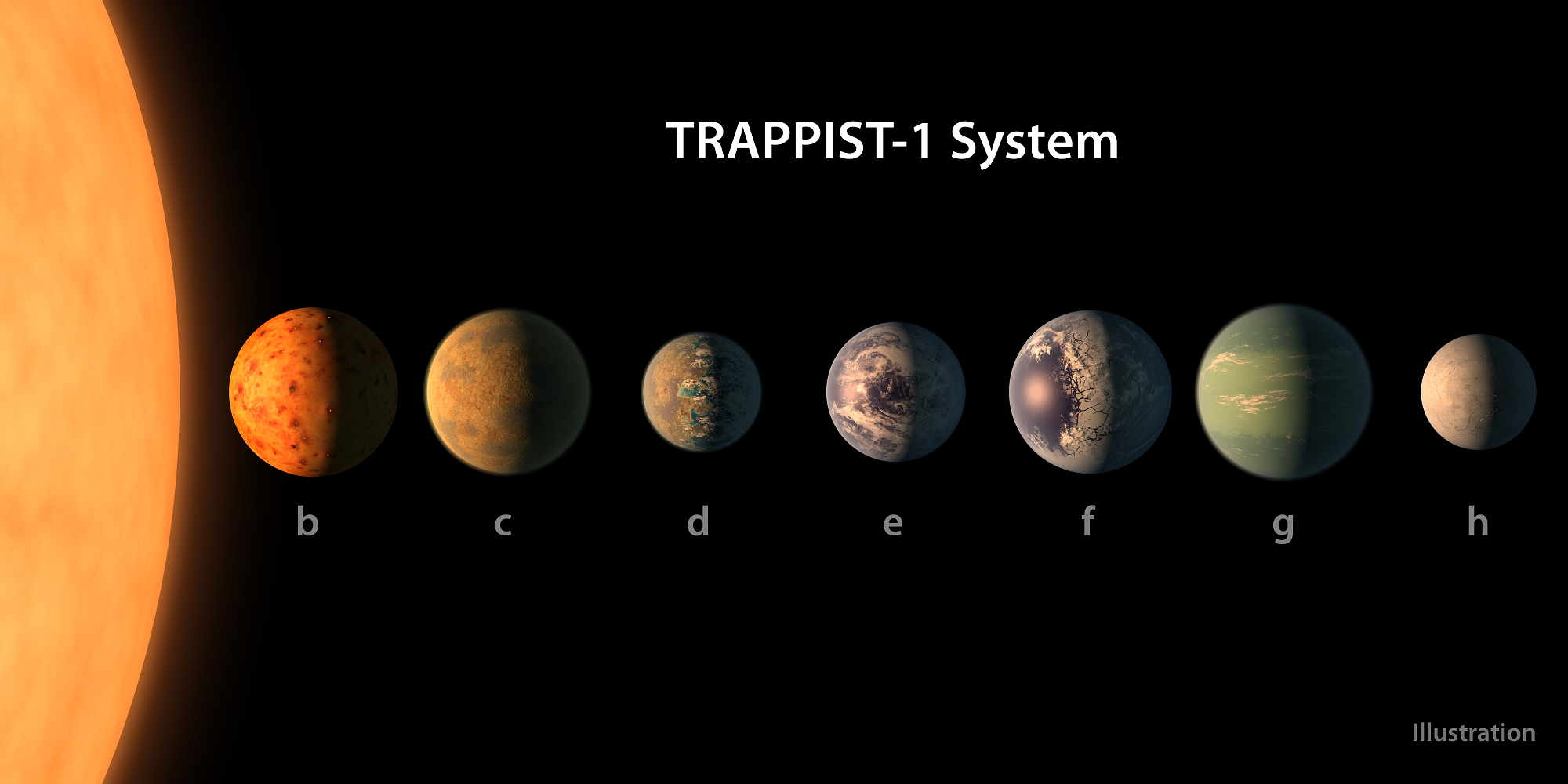
Artist’s concept showing what each of the TRAPPIST-1 planets may look like, based on available data about their sizes,
 masses and orbital distances.
 Credits: NASA/JPL-Caltech
NASA & TRAPPIST-1: A Treasure Trove of Planets Found
Published on Feb 22, 2017
Seven Earth-sized planets have been observed by NASA's Spitzer Space Telescope around a tiny, nearby, ultra-cool dwarf star called TRAPPIST-1.
Three of these planets are firmly in the habitable zone.
Over 21 days, NASA's Spitzer Space Telescope measured the drop in light as each planet passed in front of the star.
Spitzer was able to identify a total of seven rocky worlds, including three in the habitable zone, where liquid water might be found.
The video features interviews with Sean Carey, manager of the Spitzer Science Center, Caltech/IPAC; Nikole Lewis,
James Webb Space Telescope project scientist, Space Telescope Science Institute; and Michaël Gillon, principal investigator,
TRAPPIST, University of Liege, Belgium.
The system has been revealed through observations from NASA's Spitzer Space Telescope and the ground-based
TRAPPIST (TRAnsiting Planets and PlanetesImals Small Telescope) telescope, as well as other ground-based observatories.
The system was named for the TRAPPIST telescope.
NASA's Jet Propulsion Laboratory, Pasadena, California, manages the Spitzer Space Telescope mission for NASA's Science Mission Directorate,
Washington. Science operations are conducted at the Spitzer Science Center at Caltech in Pasadena.
Spacecraft operations are based at Lockheed Martin Space Systems Company, Littleton, Colorado.
Data are archived at the Infrared Science Archive housed at Caltech/IPAC. Caltech manages JPL for NASA.
For more information about Spitzer,
NASA SPITZERCALTECH SPITZER
Image Credit:
NASA/JPL-Caltech
Category
Science & Technology
License
Standard YouTube License
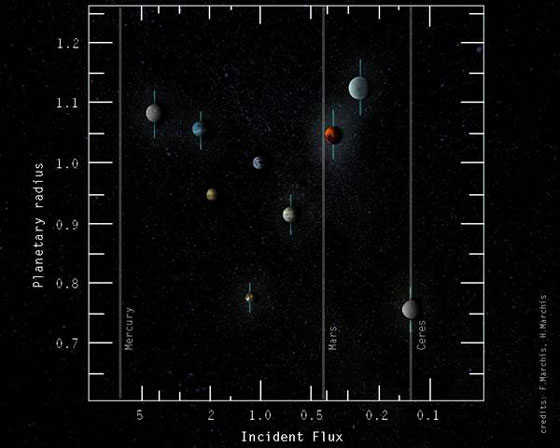
A plot of diameter versus the amount of sunlight hitting the planets in the TRAPPIST-1 system,
scaled by the size of the Earth and the amount of sunlight hitting the Earth.
Credit: F. Marchis/H. Marchis